Mikoto is Taiji — born with both the Yin and Yang currents in her body, Yin dominant. It is one of the clan's absolute rarities: a fraction of a percent are born this way, and among them she is the most complete female of her generation. For that, the Tsukikage named her the Maiden of Moonlight before she could walk.
It should sound like an honour. She has spent her life learning to wear it. Where another of these pages tells of a girl who built everything herself, and another of a girl handed everything at once, Mikoto is a third thing again: the girl who was named complete before anyone asked whether she wanted to be — and who quietly decided to become worthy of the name on her own terms, not the clan's.
Character Records
- Nature Human
-
Clan
Tsukikage
都月影 · Moon-Shadow -
Status
Maiden of Moonlight
spiritual title - Origin Inari Ōkami
- Team Team 2 Suzaku
-
Bloodline
Taiji
Yin dominant · from birth -
Dōjutsu
Hakkeigan
Awakened
The Gentleness Is A Choice
People meet her and assume the gentleness is softness — the kindness of someone who doesn't know how to be anything else. They have it exactly backwards.
Mikoto is gentle because she watched, up close and for years, what pride and power do to a person. She saw a man who loved his daughter and could not say it. She saw how a single word said at the wrong moment can define a relationship forever. So she chose gentleness the way one chooses not to draw a weapon known to be loaded — deliberately, daily, knowing precisely what the other option looks like.
That is what gives her kindness its weight. It is not the kindness of someone who can't be cruel. It is the kindness of someone who knows exactly how she would be cruel, and decides every single day not to be.
Appearance
Long, thick hair, so dark a purple it reads as black — the natural process of the Tsukikage, whose white birth-colour is slowly drawn into shadow across the years. She wears it half-up, framed at the front, the mass falling down her back beneath a purple floral clasp she is never without; loose, it falls past her waist.
The Eyes
The first thing that unsettles people: irises of a whitish lilac with no visible pupil, evenly solid, like two soft-coloured crystals set into her face. When the Hakkeigan is active, faint lights stir in them like stars dissolved in mist. The contrast — the gentleness of the colour, the absence of a pupil — makes her gaze hard to hold for long without feeling it is being returned with surgical precision.
Pale skin with a cool undertone, and a faintly pink nose-tip — the one detail that breaks the glacial composure of the whole, and, paradoxically, the one that makes her face impossible to forget. Circular metal earrings stamped with the Yin-Yang, worn in both ears, a family piece.
The Taiji Marks
On the back of each hand: the Yin mark on the left, bright and clear; the Yang on the right, present but fainter, like an echo of the one on the left. The marks of what she was born to be, worn openly — not because she chose to display them, but because there was never a way to hide what she is.
Her posture arrives before she does — upright without stiffness, occupying space effortlessly. She is not intimidating by size. She is intimidating by the quality of the attention she radiates. To be in a room with Mikoto is to be aware that someone in it sees everything.
Clan & Powers
As the Maiden of Moonlight, Mikoto carries the full Taiji inheritance of the Tsukikage — and a quiet refusal to use the worst of it.
Everything she holds, she mastered. What defines her is not the power — it is the restraint.
The Harbour With No Harbour
People confide in her before they decide to. They unburden themselves without having meant to. There is something in her presence that makes people feel safe in ways they cannot put into words — and so they open, and she listens, and she carries it.
She does not fully understand why they do this. She accepts it. She listens. She carries it. And what she carries does not disappear.
Someone who absorbs other people's pain for years needs a place to come apart — and hers is the clan's garden of Maiden-of-the-Moon Flowers, the ones her mother planted. She goes there when the weight piles too high. She does not cry in front of anyone, so as not to worry them. But in the garden, among her mother's flowers, the composure breaks, and the earth takes back what she took from everyone else.
It is the only place she is completely honest with herself — where the book of Yae's poems in her lap is only a book, and she is only herself. Some of the poems she knows by heart now. On the worst nights, she doesn't need the book.
What She Carries
Since she was small, the same dream: shadows that devour her, a chase with no escape, and always — without fail — a sky with four moons. She wakes at the same instant every time, the moment the shadow swallows her. She does not know what it means. She only knows it has not stopped, and that it has grown heavier with the years. It is the one thing she carries that she cannot set down in the garden, because it follows her into sleep.
What defines her most deeply is not the fear of being hurt — it is the fear of hurting. The Taiji Palm and the Hakke Fūin exist in her body as permanent possibilities: the power to wound with precision and the power to heal live in the same hands. That awareness makes her careful to the point of hesitating when she shouldn't.
She hates fighting — not naively, but as someone who understands the cost and refuses to romanticise it. She knows wars are sometimes necessary. She goes because there are people she wants to protect and no other way to do it. But she never goes lightly, and never reaches the other side without carrying the weight of what happened. Every time she hesitates and steps forward anyway, every time the discomfort is there and she acts in spite of it — it is the same choice, repeated. Not spectacular courage. Courage accumulated in small decisions no one sees.
The composure she keeps with everyone breaks in specific moments — when she is praised too much, when someone wants to know about her personal life, when attention concentrates on her, intensely and for too long. She looks away, gives shorter answers, finds reasons to change the subject. It is not false modesty. It is genuine discomfort at being the object of focus instead of the one focusing. She is used to holding the weight of others; being the weight herself is disorienting.
She wants to lead the Tsukikage. Not for the title — for what she would do with it. She has seen what arrogance costs, what misdirected pride costs, what the weight of a name does to the people made to carry it. She wants to be the person who changes what needs changing inside the clan — not from outside, with decrees, but from within, by being the kind of leader the clan has never had. She rarely says it aloud. She seems too delicate to hold an ambition like that. Which is precisely why no one sees her coming.
Family
The Father
The apology that never cameHe fought in the Miasma war, survived, and spent six months recovering only to lose the ability to walk for good. He is marked by two things he never resolved: the body the war kept, and the daughter he shouted at once and never apologised to. When she was seven and refused to strike the other children in training, he lost his composure and called her a disappointment — said she would dishonour the Tsukikage even as the Maiden of Moonlight. He knew he was wrong the moment the words left him. Pride never let him take them back — not that day, not in the years since. He is proud of her. But not even he always knows whether he is proud of her, or of what she represents — the title, the name, the weight the clan projects onto it. The distinction he cannot make inside himself is exactly the one Mikoto has felt for years without being able to name.
The Mother
The gentle lie, and the grief underneathShe died when Mikoto was ten, of an illness with no cure. Mikoto remembers the afternoons in the garden among the flowers her mother planted, and the evenings near the end when she read Yae's poems aloud to her — her mother loved that a goddess had written books a mortal could hold thousands of years later. One night Mikoto asked about the small scar on her mother's brow. Her mother said she had hurt herself when she was young, and kissed her on the forehead. Mikoto believed her — and never stopped feeling there was something beneath the answer her mother chose not to give. She feels for her a compassion so deep it never needed explaining, as if some part of her knew something she never had the words for.
Connections
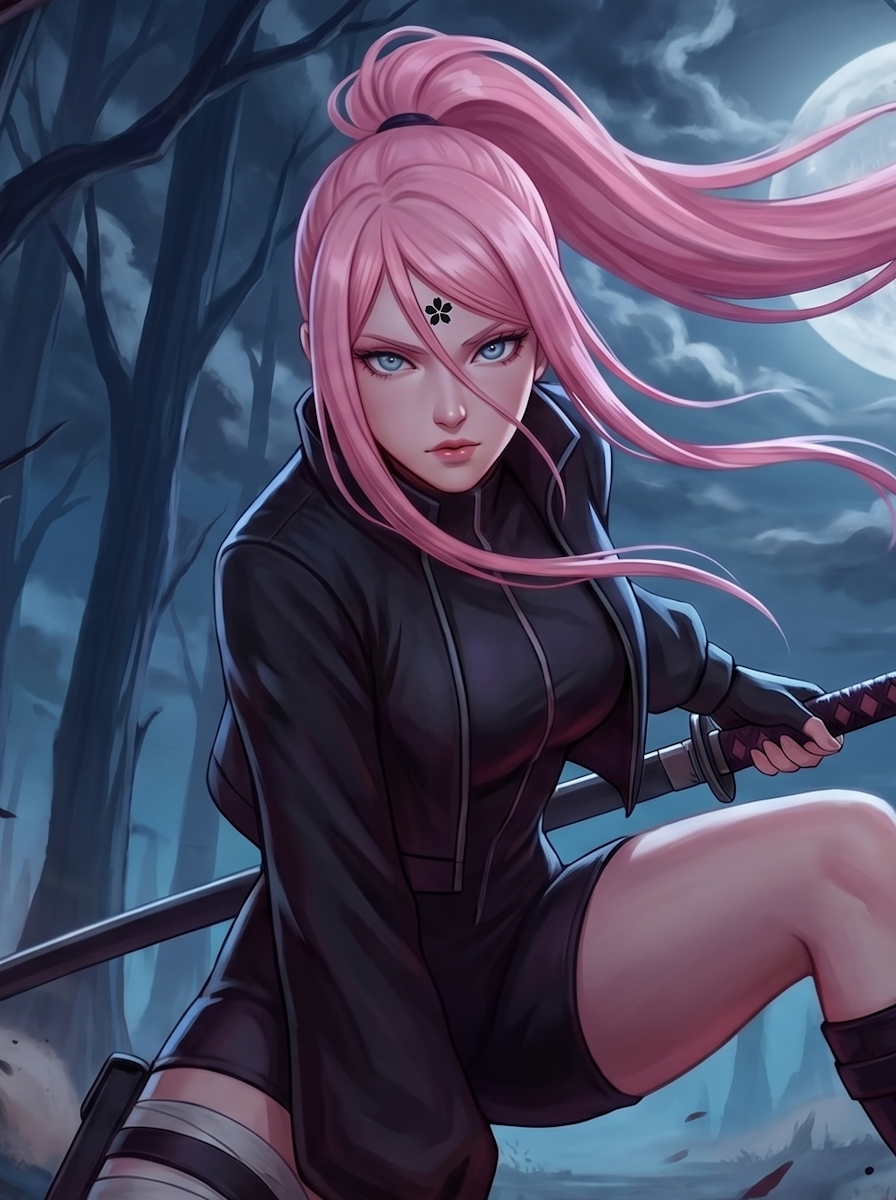
What struck Mikoto first was not technique but resilience: someone from a clan with no genetic advantage, forever measured against the Sakura it derived from, prevailing on pure skill and will. In time she noticed Tsubaki grew a little protective of her — not smothering, just the quiet attention of someone who sees a person worth protecting. They became close.
Tsubaki is one of the few who actively pushes her, who urges her forward when she hesitates. Eventually they began to train together: Mikoto helps Tsubaki with taijutsu, Tsubaki helps Mikoto with Chakra control — an exchange neither planned, which works precisely for that reason.
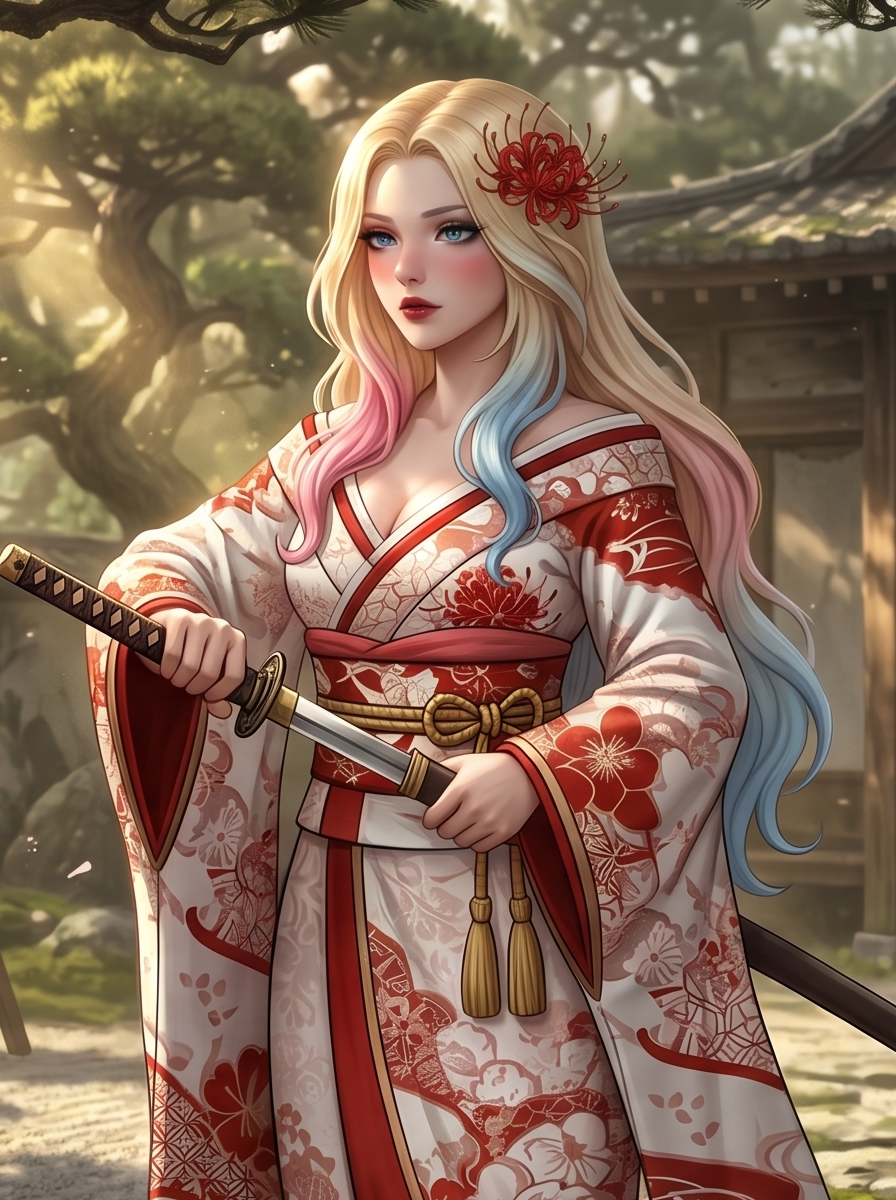
Between them is an uncomfortable mirror neither fully names: two girls carrying titles that arrived before they could choose. But Azami has the talent that justifies hers, and Mikoto has the title without the matching gift in combat — two versions of the same weight. Mikoto's admiration is not for the result; it is for the cost. She knows what it is to be called a disappointment inside the clan, so when she sees where Azami got to, she can picture — with a precision few would have — exactly how much pressure it took.
When Azami began training with Team 2, their sparring became a silent ritual — Azami insisting, every time, that Mikoto get up and try again, not with soft words but with the persistence of someone who won't accept giving up as an answer. It was Azami who taught her to keep rising.

Ren Kurohane
They were never close. They have spoken now and then since the academy, and an unspoken mutual regard settled between them without either trying. What she notices in him doesn't come from reading him on purpose — it simply arrives: a deep melancholy disguised with precision behind a face of indifference. She sees what he hides — not the details, but the weight.
And she does not act, not from indifference, but because she knows there are lines that are not hers to cross without invitation. There is an awareness in her that if he ever crosses the threshold himself, she will be there. But she will not force the door.
Arc
Mikoto begins as someone who has already arrived — the title is there, the powers are there, the clan's recognition is there. But arrived is not the same as chose. And there is a difference between carrying a weight and understanding why you carry it.
The tension that defines her is invisible to anyone watching. The nightmares sharpen. The garden takes in what she takes in from everyone. Her father shares a house with an apology that will never come. And she goes on — delicate by principle, ambitious in silence, the safe harbour for everyone without anyone being hers.
She is not a person waiting to be rescued; she is a person slowly deciding, in private, who she will be when she stops being only what others needed her to be. The gentleness will not change. What changes is that, in the end, she will know why she chose it — and choose it again anyway.
She was named for divine weight. In the end, she chose it — not because she had to, but because she understood exactly what it cost.